When you purchase through links on our situation , we may earn an affiliate commission . Here ’s how it works .
There ’s a binary headliner system out there in theMilky Way , and it ’s acting very eldritch .
" AG Draconis , " as astronomers call it , is made up of two maven : arelatively nerveless giantand a relatively hotwhite nanus — the star remains of a low- to medium - size star . They’re16,000 light - years awayfrom Earth . ( A light - twelvemonth is the distance light travel in a year , meaning everything we see happening on these stars hap 16,000 years ago ) . And that distance make them difficult to discover in detail . But we do know some thing about them .

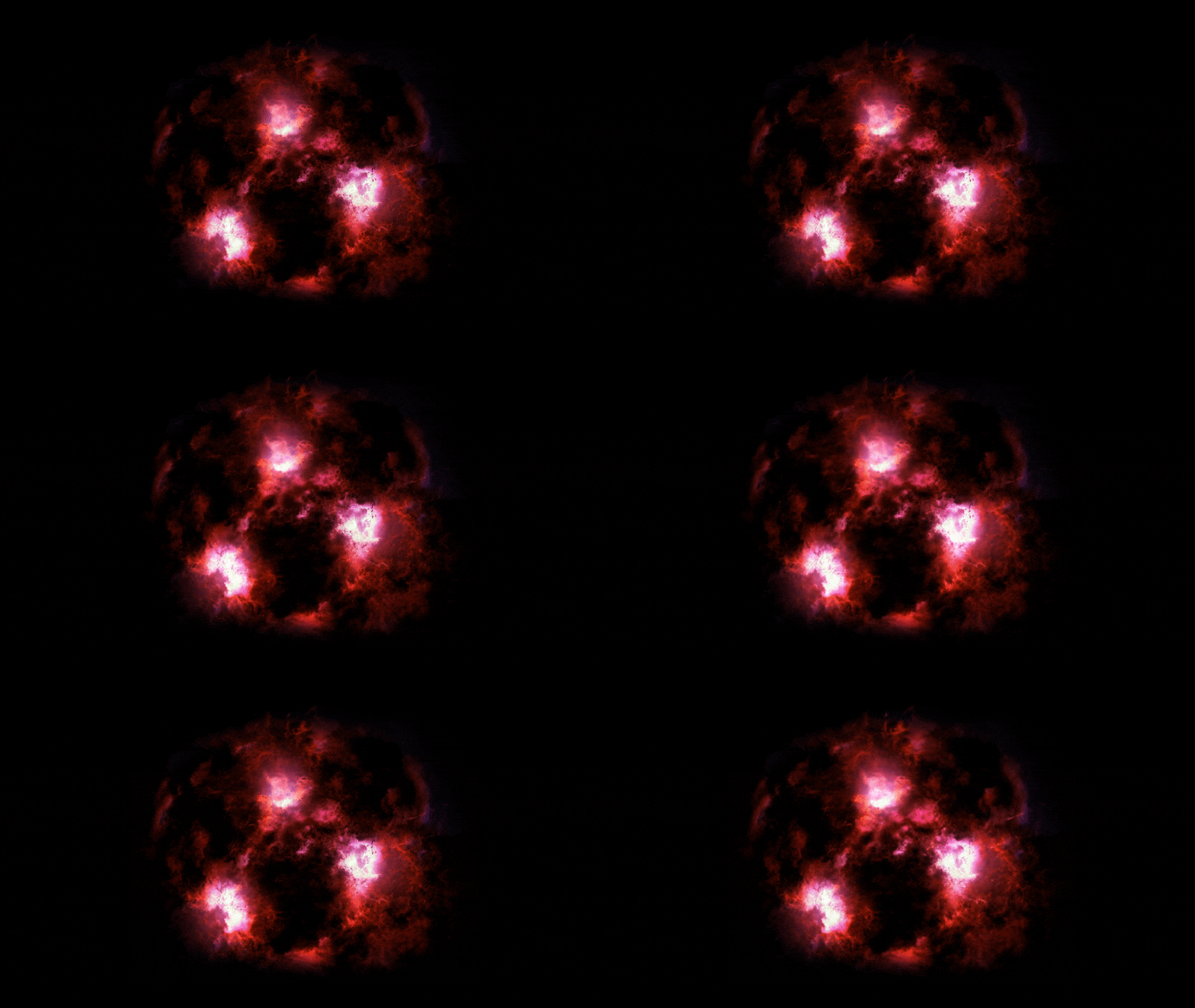
This illustration shows what a binary star system with a red giant feeding material into a white dwarf might look like.
The two hotshot are probably interacting , with cloth flowing off the surface of the big , cool star and onto the surface of the small , hot star . And every once in a while , about once every nine to 15 years dating back to the 1890s , they become active — break through a flow of several years where , once a year , they get much brighter in sealed wavelength that Earth ’s telescope can detect . They ’re in an fighting period now , with flashgun ( or " outburst " of energy ) detected in April 2016 , May 2017 and April 2018 . ( The 2016 outburst was a morsel weird itself , having two superlative two hebdomad apart . ) research worker anticipate another ebullition in April or May of this year , though it ’s too soon for any account to have been published .
But there ’s something weird about this full stop of activity , as investigator report in a paper uploaded May 10 to the preprint serverarXiv , which has not yet been through peer revaluation . [ 15 Amazing Images of ace ]
In the past , AG Draconis ' active period almost always follow a dim-witted pattern : The first couple of outbursts are " nerveless , " with the temperature of the white midget appear to knock off during each of its blowup . Then , sometimes , the next set of effusion are " hot , " with the star ’s temperature mount . Cool flare-up lean to be much bright than red-hot ones .

researcher suspect that a nerveless gush happen when the white dwarf starts to expand , its outmost , atmosphere - comparable realm raise and cooling at the same clock time . That does n’t happen during raging burst , which are less well - understand .
But this current hertz is weird . hap just seven long time after a minor effusion in 2008 , it ’s been made up entirely of " hot " outbursts .
" Such behaviour is considerably peculiar in [ the ] almost 130 - year history of [ the ] discover of this object , " the researchers write , offer no account for why it might be happening .

Why does any of this " outbursting " pass at all ? No one knows for certain .
The researchers direct to a newspaper from 2006 post toarXivthat offers one democratic explanation , derive from a different superstar system . As the blank dwarf ’s gravitycaptures materialfrom its giant twin , an " accumulation disk " forms — made up of material circling the dwarf and waitress to go down onto its surface . But the disk is fluid , with the giant sometimes feeding more stuff into it and sometimes less .
Every once in a while , too much textile falls onto the gnome ’s surface and there ’s a stiletto heel in thermonuclear burning on the outside of the wiz , where there should be fairly short . That hellish blaze away spits textile out into the system , forming a abbreviated , hot shell around the clean dwarf . From Earth , this all looks like a slight tweak in the light across a few wavelength .

" The next evolution of AG Dra[conis ] is an open interrogation , " the researcher write . In 2019 , they asked , " can we expect ( ultimately ) a major , cool or ( again ) minor , live outburst ? "
It ’s also potential , the researchers suggested , that this period of venial outbursts will simply terminate . That happened once before , during the relatively venial activity point of 1963 to 1966 .
foresightful full term , they say , this illustrates the grandness of observe a careful eye on stars like these , so that astronomers may one Clarence Shepard Day Jr. crack the code of their deportment . It also evidence the difficulty of parsingevents in solar organization short - twelvemonth away .

in the beginning published onLive scientific discipline .