When you purchase through links on our site , we may earn an affiliate mission . Here ’s how it work .
A special type ofultraviolet ( UV ) lightmay be able to " zap " grippe germ right out of the air , a fresh work suggests .
The survey chance that " far ultraviolet one C " ( far - UVC ) light could kill airborneflu virusparticles in a lab scene that was designed to be similar to a public space . What ’s more , the researchers have antecedently shown that this eccentric of ultraviolet radiation lighter does n’t damage human tissue paper .

These images show cells infected with the flu. The cells were exposed to flu virus particles that were treated with increasing doses of far-UVC light, which killed the virus. Infected cells are green, and uninfected cells are blue.
Although the new findings still want to be confirmed with future studies , it ’s possible that one Clarence Shepard Day Jr. , this ignitor might be used in public spaces as a " secure and effective method acting for limiting the transmittance and scatter of airborne - mediated microbial disease , such as influenza , " David Brenner , managing director of the Center for Radiological Research at Columbia University Irving Medical Center in New York , say in a argument .
The work was published today ( Feb. 9 ) in thejournal Scientific Reports .
Researchers have known for decades that so - forebode broad - spectrum UVC light , which has a wavelength between 200 and 400 nanometer ( nm ) , is good at killing bacteria and viruses . In fact , a " disinfectant UVC lamp " is often used to disinfect surgical equipment . However , this UV light is wild to human health , and can causeskin cancerand cataract , Brenner say . [ 27 withering infective disease ]
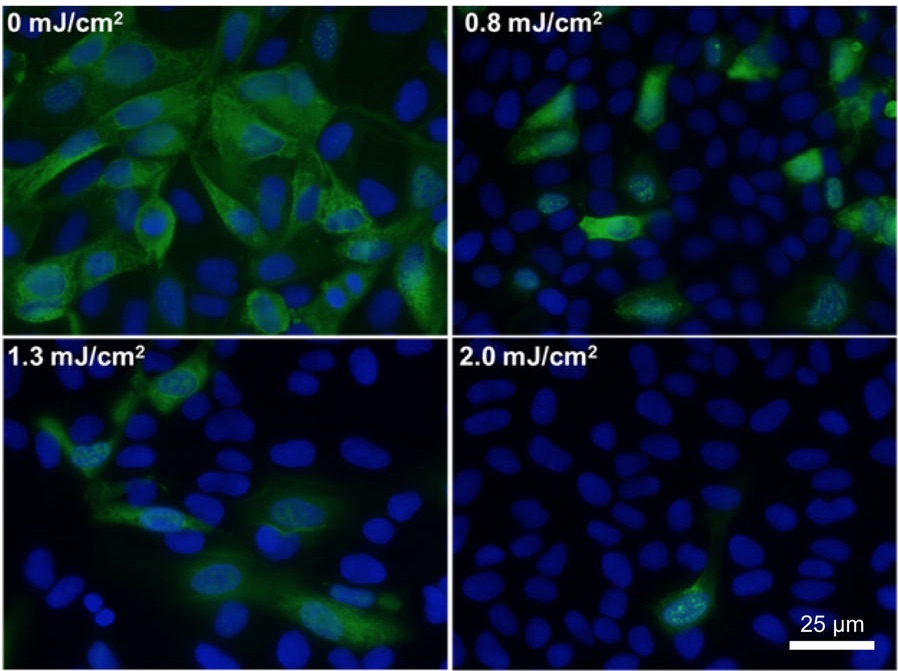
These images show cells infected with the flu. The cells were exposed to flu virus particles that were treated with increasing doses of far-UVC light, which killed the virus. Infected cells are green, and uninfected cells are blue.
But recently , Brenner and his colleagues found that a narrow-minded grasp of UVC light — far - UVC Light Within , around 207 to 222 nm — could kill micro-organism without causing biological damage to exposed skin .
" Far - UVC light has a very limited range and can not penetrate through the outer idle - cell stratum of human hide or the tear layer in the eye , so it ’s not a human health hazard , " Brenner read . " But because viruses and bacterium are much smaller than human cells , far - UVC light can reach their deoxyribonucleic acid and kill them . "
In the new field , the researcher resign aerosolized particle of theH1N1 influenza virusinto a exam bedchamber , which was designed to simulate human cough and breathing . Then , they use abject doses of far - UVC light , and found that the light efficiently inactivated more than 95 percent of the flu computer virus particles — about the same strength as a conventional disinfectant UVC lamp . When the researchers exposed skin cells to the airborne flu viruses that were treated with far - UVC light , the viruses were not able to infect the peel cellular phone .

The research worker remark that while the effectiveness of far - UVC brightness might depart depending on the microbe ( for example , the spirit level of viral deactivation might be different with other breed of flu ) , these magnetic variation are unlikely to be very large .
The study was funded by the Shostack Foundation ( a philanthropic organization ) and the National Institutes of Health .
Original clause onLive Science .


