When you buy through links on our land site , we may earn an affiliate commission . Here ’s how it works .
originally this calendar week , Live Science report thatNASA’sJames Webb Space Telescope(JWST ) could likelydetect sign of extraterrestrial life on an Earth - alike planet up to 50 abstemious - years away . Now , a new study reveals that the province - of - the - graphics space vehicle may have already spotted one such trace of spirit — " exotic farts " — in the atmosphere of a potentially sea - covered " Linosyris vulgaris " Earth more than doubly as far away .
The exoplanet in interrogation , K2 - 18 b , is a sub - Neptune planet ( between the size of Earth andNeptune ) that orbits in thehabitable zonearound a crimson gnome superstar more or less 120 wakeful - years from thesun . K2 - 18 b , which is around 8.6 times more monolithic than our major planet and around 2.6 fourth dimension as all-embracing , wasfirst discoveredby NASA ’s Kepler telescope in 2015 . And in 2018 , NASA ’s Hubble telescopediscovered H2O in the exoplanet ’s atmosphere .

An artist’s interpretation of the potentially ocean-covered exoplanet K2-18 b, which is around 120 light-years from Earth.
In the new study , which was uploaded to the pre - print serverarXivon Sept. 11 ( and will be published in a forthcoming issue of The Astrophysical Journal Letters ) , research worker usedJWSTto further analyze ignitor that had passed through K2 - 18 b ’s atmosphere .
Related:10 extreme exoplanets that are out of this world
The resulting atmospherical spectrum , which is the most detailed of its kind ever to be captured from a habitable sub - Neptune satellite , show up that the exoplanet ’s standard atmosphere contains with child amounts ofhydrogen , methane and carbon dioxide , and low level of ammonia water . Those chemical markers paint a picture that K2 - 18 b could be a hycean world — an exoplanet with a atomic number 1 - rich atmosphere and a water ocean covering an icy mantle .

An artist’s interpretation of what a hycean planet might look like.
Hycean worldsare a quality nominee to harbor extraterrestrial life . However , even if K2 - 18 b does have an sea , there is no warrantee that it would be suitable for life : It may be too hot to support life story or miss the require nutrient and chemicals to activate life .
investigator also detected what they consider are traces of dimethyl sulfide ( DMS ) , a foul - smelling chemical substance that is only known to be produced by microscopic life in Earth ’s oceans .
DMS is principally emitted by phytoplankton , or photosynthetic alga , in Earth ’s oceans . It is made from sulfur , C and H and is the most abundant organic signifier of atomic number 16 in Earth ’s atmospheric state , which pull in it one of the fundamental biosignatures , or signs of biological life , on our major planet .
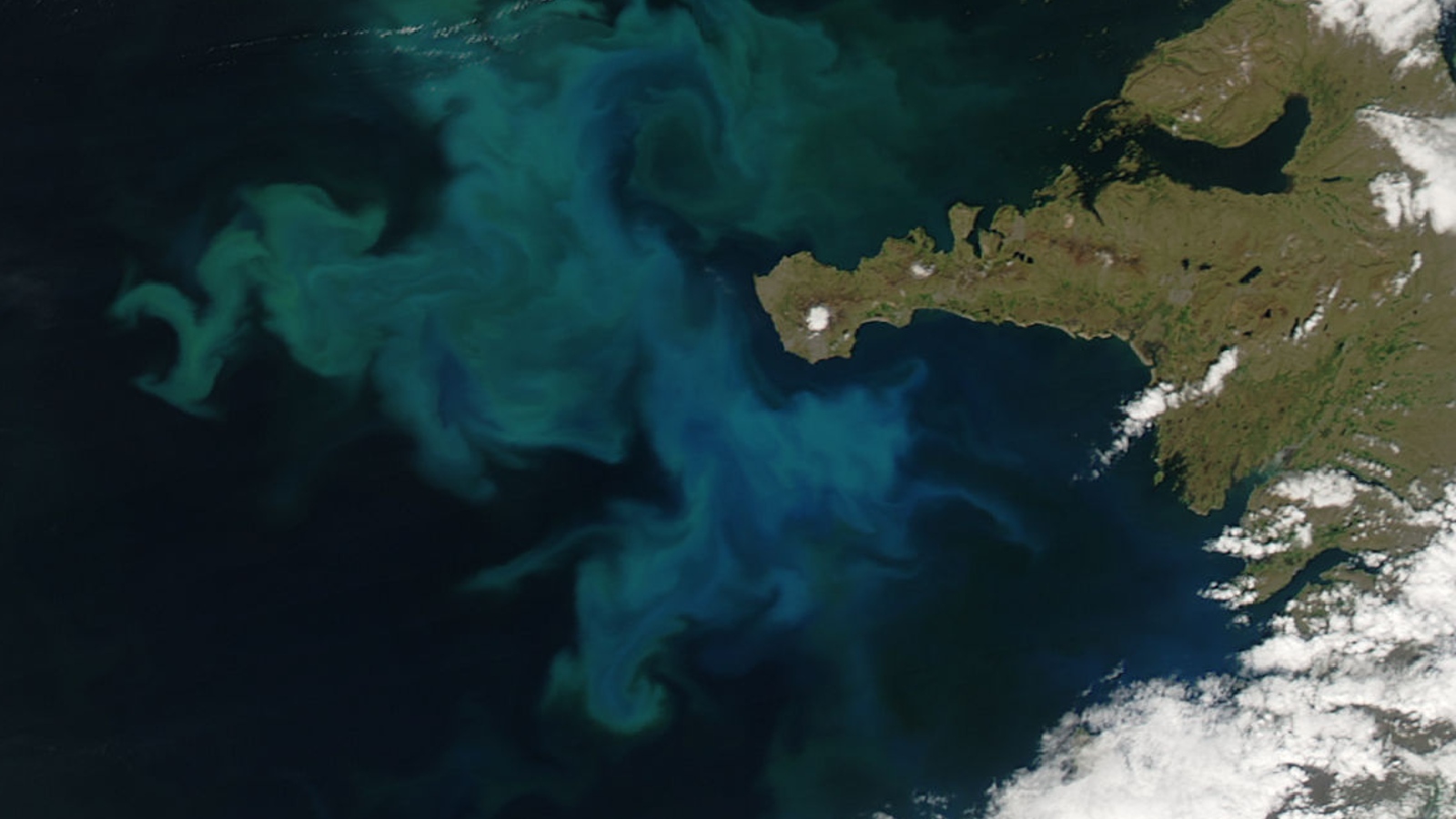
A massive bloom of phytoplankton off the coast of Iceland in 2010. These mini creatures are the main source of DMS on Earth.
However , the grounds of DMS " requires further validation , " researchers write in astatement . It is also possible that some unidentified geologic physical process could produce the chemical alternatively of biological life story , they contribute .
Related : humankind will never survive on an exoplanet , Nobel Laureate state
Regardless of whether or not K2 - 18 b does harbor alien lifeforms , the event of the new study further foreground that Hycean worlds may be idealistic place to look for extraterrestrial life .

" Traditionally , the hunt for lifetime on exoplanets has focused primarily on smaller rough planets , but the larger Hycean cosmos are significantly more conducive to atmospheric observations , " study confidential information authorNikku Madhusudhan , an astrophysicist and exoplanetary scientist at the University of Cambridge in England , said in the statement .
It is unclear how many Hycean worlds there are but " sub - Neptunes are the most common case of satellite known so far in the galaxy , " study co - authorSubhajit Sarkar , an astrophysicist at Cardiff University in Wales , read in the assertion .
The study also highlight the unbelievable power of JWST compare to precursor like Hubble and Kepler , the researchers added .

— Mirror - like exoplanet that ' should n’t live ' is the glazed world ever discovered
— 1st exoplanet outside the Milky Way mayhap discovered
— New class of exoplanet — half - rock , half - water — bring out orbit red dwarf

" This upshot was only potential because of the extended wavelength range of a function and unprecedented sensibility of JWST , " Madhusudhan said . The Hubble telescope would have required at least eight metre as many observations of K2 - 18 vitamin B to gain the same point of point , he bestow .
The researcher are planning to use JWST to take another face at K2 - 18 Bel in the future to see if the telescope can find any more evidence of extraterrestrial life on the exoplanet . If it does , it " would transform our savvy of our place in the universe , " Madhusudhan say .


